Posts

Is Global Warming a Myth? How to respond to people who doubt the human impact on the climate

Image
Dear EarthTalk: I keep meeting people who say that human-induced global warming is only theory, that just as many scientists doubt it as believe it. Can you settle the score? -- J. Proctor, London, UK So-called “global warming skeptics” are indeed getting more vocal than ever, and banding together to show their solidarity against the scientific consensus that has concluded that global warming is caused by emissions from human activities. Upwards of 800 skeptics (most of whom are not scientists) took part in the second annual International Conference on Climate Change—sponsored by the Heartland Institute, a conservative think tank—in March 2009. Keynote speaker and Massachusetts Institute of Technology meteorologist Richard Lindzen told the gathering that “there is no substantive basis for predictions of sizeable global warming due to observed increases in minor greenhouse gases such as carbon dioxide, methane and chlorofluorocarbons.” Most skeptics attribute global warming—few if any...

Earth’s Climate And Ocean Acidification History

A scientific research cruise following the palaeo-equator has uncovered nearly 53 million years of climate and ocean acidification history। Three scientists from the National Oceanography Centre, Southampton were onboard. The Integrated Ocean Drilling Program drillship JOIDES Resolution has returned to Honolulu after a two-month voyage to chart the detailed climate history of the Earth. This was the first of two voyages of the ‘Pacific Equatorial Age Transect’ project, and the first international scientific drilling expedition since the JOIDES Resolution underwent a multi-year, more than $100-million transformation into a 21st century floating science laboratory. Onboard were 29 scientists from seven nations, 25 technicians, and an international crew of 66. The first expedition, led by Heiko Pälike of the University of Southampton’s School of Ocean and Earth Science, based at the Centre, and Hiroshi Nishi (Sapporo, Japan), ended on 4 May after successfully coring over 3.5 km of the sed...

Eyes on the स्विने Could animal surveillance have seen the new flu coming?

Image
This article will appear in the July issue of Scientific American. We are posting it early in light of a report today in the journal Science that bears on similar themes. The study, led by Nancy J. Cox of the Centers of Disease Control and Prevention describes a molecular analysis of the novel influenza A (H1N1) virus infecting humans in several parts of the world. The authors confirm that the new strain is comprised of segments from swine flu strains known to circulate in Europe, Asia and North America, but that this combination has not previously been seen and appears to have been evolving independently from its parent strains for some time. Noting the "relative lack of surveillance for swine influenza viruses," the authors suggest, "this virus might have been circulating undetected among swine herds somewhere in the world." The study also confirms that the "H1" hemagluttinin protein of the new virus derives from the classical swine H1N1 strain, which ...

Heat-tolerant Coral Reefs Discovered: May Survive Global Warming

Image
Experts say that more than half of the world's coral reefs could disappear in the next 50 years, in large part because of higher ocean temperatures caused by climate change। But now Stanford University scientists have found evidence that some coral reefs are adapting and may actually survive global वार्मिन। A toppled but surviving table-top coral at Ofu Island, American Samoa. This coral species hosts heat-resistant algae and thrives in Ofu's high-temperature लगून्स "Corals are certainly threatened by environmental change, but this research has really sparked the notion that corals may be tougher than we thought," said Stephen Palumbi, a professor of biology and a senior fellow at Stanford's Woods Institute for the Environment. Palumbi and his Stanford colleagues began studying the resiliency of coral reefs in the Pacific Ocean in 2006 with the support of a Woods Institute Environmental Venture Project grant. The project has expanded and is now being funded by Co...

Surprising Twist To Photosynthesis: Scientists Swap Key Metal Necessary For Turning Sunlight Into Chemical Energy

Image
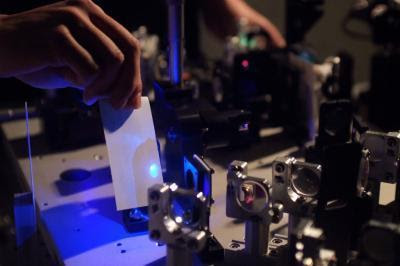
The reactions that convert light to chemical energy happen in a millionth of a millionth of a second, which makes experimental observation extremely challenging. A premier ultrafast laser spectroscopic detection system established at the Biodesign Institute, with the sponsorship of the National Science Foundation, acts like a high-speed motion picture camera. It splits the light spectrum into infinitesimally discrete slivers, allowing the group to capture vast numbers of ultrafast frames from the components of these exceedingly rapid reactions. These frames are then mathematically assembled, allowing the group to make a figurative "movie" of the energy transfer events of photosynthesis Photosynthesis is a remarkable biological process that supports life on earth। Plants and photosynthetic microbes do so by harvesting light to produce their food, and in the process, also provide vital oxygen for animals and people। Now, a large, international collaboration between Arizona S...

Global warming data blunder: Worth the fuss?

Despite broad consensus on the existence, origins and potentially catastrophic effects of global warming, a vocal minority continues to question the motives, methods and assumptions of climate scientists sounding the alarm. So when temperature data released by NASA's Goddard Institute for Space Studies (GISS), one of the leading monitors of climate change, showed an unusually warm October, climate change skeptics cried foul. As it turned out, the GISS data were flawed. The relatively minor glitch was fixed and the figures updated. End of story? Of course not. Climate change skeptic Anthony Watts called the mistake a "data train wreck" in his blog. Global warming denier Christopher Booker, in a column in the U.K.'s conservative Telegraph, called the error a "surreal scientific blunder." Reality check: GISS climate modeler Gavin Schmidt notes on the blog RealClimate.org that the problem occurred because a small but significant percentage of the hund...

Soot's Dirty Hand in Global Warming

Though it pours ominously out of chimneys, forest fires and the exhaust pipes of diesel-run vehicles ( right ), soot has received little attention from scientists studying global warming . Results published today in the journal Nature, however, suggest that soot, 90 percent of which comes from burning fossil fuels and biomass, may be a leading cause of rising world temperatures. "Soot�or black carbon�may be responsible for 15 to 30 percent of global warming," says Stanford University researcher Mark Z. Jacobson, the author of the report. "Yet it's not even considered in any of the discussions about controlling climate change." The conventional model of global heat balance holds that greenhouse gases warm the earth by trapping infrared radiation, while aerosol particles in the atmosphere reflect sunlight back into space, reducing the amount of heat the planet absorbs. The aerosols, in this view, cool the earth in the same way that light-colored clothing keeps...